The newest entry is always at the top of the page


To read in the order that the entries were posted


START AT THE BOTTOM


Tuesday, September 28, 2010

My First Solo on a Tractor

As well as my Grandfather’s farm and others that I stayed on, my Uncle and Aunt had a farm about 25 plus miles away. As all the area farms in that era, it was a mixed farm. Mixed farming meaning that you raised all types of livestock, horse, chickens, geese, etc. as well as cultivating and growing grain, hay fields, etc. With the exception of salt, sugar and flour (guess some even milled the flour) most farmers were self sufficient. I actually did many of my ‘firsts’ on this farm. Both my Uncle and Aunt having passed away (Bless their souls) I can even relate some of these events that I had never admitted to them. Don’t get the wrong idea, nothing real bad – but things that would have upset my Uncle. My first solo tractor is not one of the ‘secret’ ones, as it was my Uncle that put me through the excruciating pain. The farm house sat a long way from the country road that passed in front, and there were fields on either side of the long driveway. When working the land, if the weather was nice, and no repairs were needed, often my Uncle would leave the tractor in the field for the night, then return the next morning to continue plowing, seeding, mowing, whatever the task was. After leaving the tractor one night, the next morning my Uncle took his car down the long driveway to finish up the field work. My cousin and I had walked down with his lunch, but he was just finishing up and was ready to return to the house. “Davie, do you want to drive the tractor back?” Yes – yes – yes!! I get to drive the tractor – Yahoo – finally, after all I was all of 8 years old. The tractor was a case with tip-toe* front wheels. My Uncle got me partially seated, partially standing at the steering wheel of the tractor. He then put it in the lowest gear it had, and opened the throttle to ‘one’ and let out the clutch – he then jumped off and got in his car and drove to the house. There I was – driving my first tractor at the break-neck speed of perhaps ½ mile per hour. Look disappointment up in the dictionary – you will see a picture of a kid steering a case tractor (with tip-toe* front wheels) going soooo slow that the worms on the ground are passing him. It took forever to finally arrive at the house, where my Uncle jumped on the tractor and stopped it. I have to give him credit, he did let me drive the tractor – many would not have. But ½ mile per hour – come on… my cousin thought it was very funny!! I would get even with her, just wait and see.

*tip toe – I am not sure what the correct name for this type front axle on a tractor is. We used to call them ‘tip toe’ which is when the front tires are only inches apart. This type of configuration was good for driving down rows of garden, with the front wheels and each back wheel straddling the rows. What benefit it had on a prairie farm, I am not sure, as on a side hill they had a far easier chance of tipping over than a tractor with a wide wheel base at the front.

Thursday, September 23, 2010

Back To School

Before I relate what it was like on the first day of a school year, I will explain how and why I may be referring to different types of schools in my blogs. My family lived on the edge of a small village, and I went to a two room school (grades 1 – 5 in one room, I think). After my first grade, they had built another school with an additional two rooms, and then from there they kept expanding. So as I progressed in Grades, there were more class rooms. But, I would also end up going to school from my Grandfathers home (which was 12 miles north of where I lived). This was a one room country school with grades 1 to 12 and had a barn for our horses. Also, for some reason I was ‘farmed’ out a lot when growing up and would stay with families on farms for weeks on end and would take a school bus to school. These are the reasons that in one blog I may talk about walking to school, another on the bus or on horse back. Now, that I have completely confused you! In September, when we went to school on the first day – we were not given a list of supplies that we had to buy. The teacher would have everything that we needed, pencils, crayons, work books, paper, rulers, straight pens and ink (although early versions were available we were not allowed to use ball point pens). The teacher would also give us all the text books that we would need for the year. To my knowledge no parent paid for any of these supplies. It was part of what people got for their taxes in those days. Rather than use the straight pens provided, you could use a fountain pen*, but it was your responsibility to buy it. Not having to purchase any of the school supplies had many advantages besides not costing anything. Regardless of a student’s ability (or not) to purchase ‘neat’ pencil boxes, binders, etc. – everyone had the same. This procedure also did not cause any of the turmoil and stress that I witnessed in some of the Office Supply stores at the start of this school year. Mind you, if you lost something or needed more supplies during the year, the teacher would usually put you through the 3rd degree and lecture you on the evils of chewing on your eraser, or breaking your pencil. At a later time I will write about how the black boards were actually black, the sometimes “adventure” of being the pupil who got to mix the ink powder with water, why the schools always had the smell of oil - unless there was the wonderful smell of hot soup or hot chocolate and why there was a need for three and four holer outhouses!
• A fountain pen carried a supply of ink in a reservoir, which was a rubber, sac-like container inside the pen’s barrel. On the side of the pen’s barrel is a lever. When you pull out on the lever, its other end pushes inside the pen and presses against the sac. This forces out the air from the empty sac. Then when you place the tip, or nib, of the pen into a bottle of ink and release the lever, the ink is drawn up through tiny tubes into the sac. This is called the vacuum method, since the vacuum inside the sac draws up the ink.

Sunday, September 19, 2010

The Comfort Of A Clock

I have a clock on the wall beside my desk – it is a battery operated dial clock, but still makes a ticking noise as it hits every second. Often when I am sitting here at night, when the house is quiet, this clock has the same effect as those I listened to over 60 years ago. Before we had electricity, coal oil lamps were our main source of light for the long winter nights. After the last meal of the day until we went to bed, the dim light from these lamps was what we used to do homework, read, play games, knit by, etc. The lamps gave off a warm glow, and along with the well stoked stove, helped to make you forget about the cold temperature outside and perhaps the snow storm that was going to make it difficult getting to school the next day. If everyone in the house was either reading or just sitting (also hypnotized by the clock), slowly the ticking would seem to get louder. Like a heartbeat, it added to the sense of safety we got from the lamp and stove. You noticed that I did not say a snow storm “would close” the schools, because that never happened, unless it was a full blown blizzard. Whether a country one room or the town multi room school – you were expected to get there.. I have just paused writing for a few minutes, letting the clock take me back to the coil oil lamp and stoked stove – and yes, its heartbeat is still here, keeping me safe.


Wednesday, September 15, 2010

Job’s Aplenty


This week, I am finally retired – no where to go – no deadlines – no excuse to ‘just leave the house’ – no co-workers and/or customers. Wow, this is quite a shock, as I have worked from before my teens (60+ years). When I was 7 or so, my allowance was earned by being paid a penny for every pail of peas and beans I picked for my father. I will talk about the size of our garden in a future story. One of my first jobs was working for a lady who had opened a little gift shop. She had the neatest little ornaments. When I was around 9, I would go to her store and sweep the floor, dust the shelves and merchandise, and if I was real lucky she would have some reason to leave (I am sure she did it just for the look on my face – that I was going to be in charge). I felt so important and if anyone ever made a purchase when “I was in charge”, I was an “Entrepreneur Extraordinaire” in the making! There never seemed to be a shortage of after school jobs, and if I did not like a place that I was working, I could leave (never seemed to be any hard feelings) and know another job doing something was available. The least suited job I had was working the gas pumps at a service station on the main highway that went past the town. I had a very good friend who’s Dad owned a garage in town and my friend could change large tractor tires in a jiffy – was he ever good, he could take the tire off the rim, remove the tube, fix the leak, put the tube back in then use these heavy bars and a huge hammer to force the tire back on the wheel. I had watched this many times and he actually made it look pretty easy (not so). Anyway, there I am at the gas station, and a car pulls in for gas. I ran out and filled the gas tank, pop open the hood and checked the oil and water, washed the windows and asked – “how are your tires?” When you have never actually fixed a flat tire, don’t ask ‘how are your tires’. The reply was – “Oh, I almost forgot, I have a flat in the trunk and will leave it here and pick it up in a couple of hours, just put in a new tube”. So far so good, a new tube, I would not have to try to find the leak and repair it. O.K. now, how did my friend do this? I am sure if they had video cameras in the 50s, I would have been on some ‘how to screw up’ show. After much effort I actually got the tire off of the rim, now for the easy part, just take out the old and put in the new tube, which I did. I lined up the valve stem to the hole in the rim, then took a big metal bar, and force the tire back on – done – now proudly filling it with air, I hear this ‘not good’ noise and how come it is not inflating? Off comes the tire (getting better at it now – practice makes perfect) and much to my dismay, when putting it on, I had (with the big metal bar) ripped the new tube to shreds. O.K. pretend you are setting up Ikea furniture – and it reads “to assemble this section, follow the same directions as Picture B”, which it seems I was about to do – exactly the same. Once more, another new tube and being more careful this time when replacing the tire, everything looks good haha! (Look at me - I did it!!!). - Now where is that air hose? Nooooo – again that noise! Well three times right (or something like that) – finally I ended up with a tire complete with a new tube, filled with air – with my clothes completely filthy, and two brand new tubes in shreds! I am basically a very truthful person, but I am sorry folks – any trace of the two ruined new tubes, were never to be found – ever. For the rest of that job, when a car pulled up and I would rush out - I always seemed to forget to ask “how are your tires?” Another job was when I was around 14, my father was hospitalized for a few weeks. I was allowed to stay out of school to look after his hardware/lumber yard business. Like the store keeper and the cigarettes, I got to enter the items in customers ‘books’. I had to rely on the honesty of people when they purchased lumber – I truly had no idea. The hardest part of looking after Dad’s store was when someone would buy bags of cement – damn those things are heavy, and at the time, I was built like the ‘skinny kid at the beach’ that was having sand kicked in his face. Many of my other paying jobs were working on farms, from about age 12 until I left for the Army on my 16th birthday. My farming experiences were many, which I hope to relate over the life of this blog. Another after school job (that many of the town’s kids had) was hauling wood, coal and water (no indoor plumbing) for various ‘real old’ townswomen, who I now realize were most likely still in their 50s. When we had sub zero temperatures and it would be snowing, sometimes it was very difficult to give up our warm homes to haul the wood etc, but we did (for all those old - old women), and I am sure for the rest of our lives it has and will continue to help us realize the value of dependability and promptness.

Thursday, September 9, 2010

When Did I First Ride a Horse?

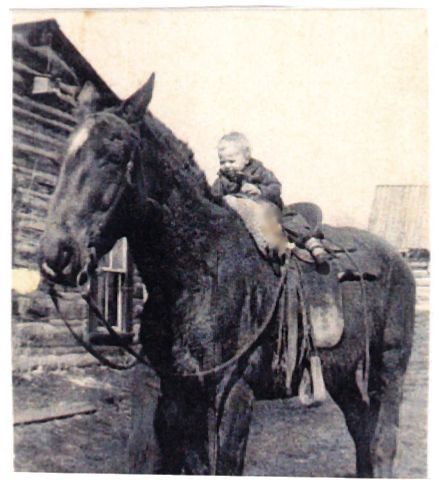
As you can see by the picture, I literally grew up with no fear of horses. Naturally the photo was posed, and I am sure someone was off to the side to catch me if and when I fell off. This particular horses name was Jim – yup plain ole Jim. Jim was a retired RCMP horse that was actually used in their line of work and not just for the famous RCMP Musical Ride http://www.youtube.com/watch?v=gAOeGLiTvBk. I have memories of riding Jim on my own when I was 4 years old. I would go into the pasture with a cube of sugar and a halter, give Jim the sugar and then he would patiently wait until I buckled the halter. We would then go beside a wooden fence (so I could get on) and once aboard ride around, bareback and with just a halter. We rode around the farm yard and most often up the “mountain” and across the ‘river’ that I mentioned in an earlier blog. Jim, although very tolerant with me, had certain rules that I had to follow – and once taught I never forgot. The main rule was the proper way to mount a horse is on the left – NOT the right! I learned this rule, when I took him beside the fence on his right side, climbed up to the top board and he turned his head and nudged my leg enough for me to have to regain my balance, once more he nudged me – then finally he bit my leg. A horses jaw does not move – it is just a clamp – teeth onto teeth – and damn does it hurt! Since then, I have never, ever tried to mount a horse on the right hand side. As with many farmers of the 40s, most did not have the luxury of more than one riding horse (if that) and often you would ride work horses. Although Jim was a riding horse, he was also teamed with ‘Molly’ to do the heavy work. I have many stories where Jim and I both rode and worked together – although a few are somewhat scary they all are fantastic. I was so lucky.

Monday, September 6, 2010

Choosing Sides

Although I refer to growing up in a town, it was actually a village, which even then was stretching it – the population was shy of 300. Today, they have it right, and it is now officially a Hamlet, with a population between 300 and 400. For the ‘town’ to still exist is an accomplishment, as in the past 60 years many of the small ‘towns’ have disappeared. I will continue to use ‘town’ when relating any events that happened there. Because the majority of school pupils were bussed in from their farms, there were not many kids that actually lived and played in the town. Any time that we played a game that consisted of teams, the normal procedure was to pick the teams. I hated this procedure, as I was usually one of the last picked. Normally the two most popular or best players would get to be Team Captains.  Everyone would be standing around in a group, knowing pretty well exactly the order each was going to be chosen. Even knowing this order, deep down I would hope that perhaps “this time”, something magical would cause me to be moved up in the order of picking. As it happened so often, it was not really an embarrassment, and I am sure none of the other kids gave it much thought - except those that were still standing, waiting with me to be picked. I know that today there are still kids ‘standing and waiting and hoping for the magic to happen. Hey – Team Captains - put everyone’s name in a hat - pick your teams that way! I am sure being one of the last picked, has had an effect on how I dealt and still deal with life as an adult. Through my life I have, on many occasions, been an ally of someone who I felt was not being treated as an equal, and was being ‘one of the last to be picked’. So – although at the time it hurt, it gave me the compassion to understand the pain of others, and to try to help.

Saturday, August 28, 2010

Credit Before Plastic

In the 40s and 50s the majority of people in my town used credit for most of their purchases. The different Store Owners would usually have a drawer, shelves or folder where they stored small ‘bill books’ each with a customers name on them. Every time a family member would buy something it would be written into the book. Some merchants would keep a running total so that people knew if they were overspending. At the end of the month when, those that had wage earning jobs got paid, they would go to the various places where they had purchased items, and pay the bill. Our town (as most outside of Edmonton) was a farming center, and I am not sure exactly how they would arrange to pay their bills. A farmer’s income depended on when they sold grain or livestock, and I am sure the Store Keepers would have to wait until a farmer had the cash coming in. It must have been difficult for the shop owners to ‘carry’ so many people for a month or more, and I am sure there must have been families who were never able to pay their accounts in full. I said in my intro to this Blog that I did not want my Great Grands (too late for my Grands) to do some of the idiotic things that I did. WELL – I will relate the story of my first cigar another time – but for now - My mother smoked a brand of cigarette called Dailey Mail, which along with Vogue were 1 cent cheaper per pack than all other brands. 28 cents vs. 29 cents. Often my mother would get me to pick up some items at the store including packs of cigarettes. This gave me the opportunity to replenish my ‘smokes’ when needed as I could just put them on the bill. I was around 12 years old (I know – I am not proud of it now) when my mother asked me – “Davie are you charging cigarettes on the bill?” I, of course, said NO – I don’t smoke (gulp). My mother replied “then what are these cigarettes on the bill for 28 cents?” I had not noticed that the month before my mother had switched brands to Players (a 29 cent brand)!!! Caught! – One of many times!

Hopalong Cassidy - Tom Mix - The Lone Ranger (and Tonto too)

As well as being a gathering place for people when the train arrived three times a week, for the boys of the town, the Train Station was a playground and one of many places for us to get into trouble. Not that I, Davie would ever get into trouble. (In my early years I was never called a ‘chicken’ – and if others were going to do ‘something’, I would be there). Often many of the ‘somethings’ were not the wisest but “hey’ we had to entertain ourselves. The rail siding at the station would usually have a few freight cars sitting idle. Most of them would be waiting for grain to be loaded from one of the two Grain Elevators located beside the tracks, or perhaps, from time to time, livestock. After the once weekly movie at the Community Center Hall (at least every third week, a western) with Hopalong, Tom Mix, Gene Autry, Roy Rogers or the Lone Ranger and Tonto too, these rail cars were one of many places for us to relive some of the amazing things our ‘hero’s had done. We would often play Cowboys and Indians (I am sorry, I realize this is not politically correct – but at the time it was). These freight cars were great to chase each other along the tops, having to jump from car to car, scurrying down the ladders and running along the tracks – up another ladder and now you would be behind your chaser. Yeaaaa – you got him!!! When shot, the dying scenes were something to behold, utter acting at its best! The longer it took you to die, the more you could make your ‘killer’ laugh! I am not sure where the Station Master was when we would have these fierce battles, sleeping perhaps, but every once in awhile he would ”wake up” – and we would run away, laughing because we had been so brave at both ‘running the tops of the cars’ and getting away from the Station Master. Thinking back now, with only about 10 boys in the whole town, obviously when we ran away, everyone knew who we were. (Chuckle)  Once far enough from the Station to regroup, we would then decide where our next ‘playground’ would be. The lucky part , although there were many slips, no one ever fell off one of the freight cars - but then again, who ever heard of The Lone Ranger (and Tonto too) falling off a train.             
                                                                                                                      

Monday, August 23, 2010

Lifebouy Soap

Of all the senses, smell can bring back more memories than any of the others. Whenever I would go to my Grandpa’s farm from about age 4 until 10 or 11, the first smell as you entered the house was Lifebuoy Soap. The wash stand was just inside the back door. I just loved that smell! My mother, perhaps because of price (I think lifebuoy would have been a cent or more than the other brands) never had lifebuoy in our house. I was never cleaner than when I visited Grampa. I loved washing my face using this fantastic smelling soap. On arriving for one of my many lengthy stays, the first thing I would do (after hugging the dog) was check and sees which colour the soap was - white or red. Not having running water, you would wash in a basin with cold water from a large jug that sat beside the sink. If you wanted warm water, you would take it from the reservoir on the wood burning kitchen stove. Lifebuoy is still sold today, but they have cut down on the smell (or perhaps it does not have the same attraction to an adult) - BUT every time I go down a supermarket soap isle - and see the Lifebuoy label - I am back at Grandpa’s scrubbing behind my ears and smelling 'oh so nice'.http://graphic-design.tjs-labs.com/show-picture?id=1062779059&size=FULL

Saturday, August 21, 2010

That Wonderful Smell of Freshly Thawed Clothes

Wash day (usually a Monday, not sure why) was a square tub and a scrub board. First thing in the morning the wood burning cook stove would be stoked up high to heat up the water reservoir* and the various kettles and large pans filled with water on the stove top. Very hot water would be poured into the tub, and the clothes, towels, etc. would be scrubbed using a bar of laundry soap. The rule was ‘the hotter the water, the cleaner the clothes”. Once clean, you would dunk the clothes into another tub with cold rinse water, and then wring them out by hand.
I remember watching this, but never had to do it myself. When I was 7 we got a “real” washing machine (for the life of me, I do not know where we stored it) but on wash day it would be in the middle of the room. The tub part was made of wood staves (like a wine barrel) and the center agitator was turned by gears underneath the machine, which moved when you pushed and pulled a handle on the front. The agitator would go back and forth as you pulled the handle – the larger the load the harder it was to work that handle. You would think a 7 year old would be too young to take his turn pushing and pulling the handle – WRONG. As with all other daily chores, if you were able, you did it! We used Fels Naphtha bar soap (you would cut off slivers and put in the wash water). Some people would save up the little pieces of left over hand soap and put them in an old lard or syrup pail that they had put many holes in – they would then swirl the container around in the water until some suds appeared. I am not sure how cleansing this was for the clothes, but that is what was done. Once clean, you would put the wash through a hand cranked wringer (attached to the tub) into a rinse tub. After rinsing, you would again put them through the wringer and finally they were ready to hang outside to dry. Everyone’s yard had a clothes line and wedge type wooden pegs were used to hold the clothes on the line. During the summer months drying clothes was rather uneventful, but in the winter it was magic. We had 5 – 7 months of freezing weather (the reason for wooden clothes pegs – metal hinge types would have frozen together). The magic happened when, in the winter, you hung wet clothes out to dry and almost immediately, they would freeze. I am not sure exactly how we knew it was time to bring them back into the house – but in they came FROZEN STIFF (like carrying a sheet of cardboard), and once they thawed, they were dry! Now that is magic! And then - That Wonderful Smell of Freshly Thawed Clothes!

*Reservoir – was a built-in container on a wood burning cook stove that held about 2 gallons of water. The water would always be warm from the heat of the stove. There would be a dipper (ladle) near by for you to scoop water out into your wash basin, etc.

Saturday, August 7, 2010

Baby Chicks Are Coming Tonght!

The arrival of the train from the big city was a reason for many of the townsfolk to gather at the station. Don’t forget this was before TV and the train arriving (3 times a week, if I remember correctly) was a great interruption of everyone’s daily and nightly routines. The train would arrive around 6 PM and usually have one coach car, a mail car, sometimes a freight car and the caboose. Most people came out of curiosity and, for some of the kids, to put pennies on the track (to the admonishment of most of the adults). It is amazing how thin a penny becomes when a huge steam locomotive runs over it. After the train pulled in to the station you would hear people remarking “look who just came home” or “wonder who the parcel from Sears is for?” The biggest turn-out for the train would be when word got out that a farmers baby chicks were arriving. Everyone would be gathered around waiting for the small 3 by 3 foot flat cardboard boxes containing the fluffy little (oh so little and oh so cute) chicks to be unloaded. If it was in the spring or fall when the weather was somewhat chilly, the farmers would quickly cover the boxes with blankets and hurriedly load them in their car or the cab of their truck. You had to be quick to get a glimpse – but everyone seemed to be a little bit happier on their walk back home.

Thursday, August 5, 2010

I Get My Own Bedroom

When my Dad came home from the Army in 1945/46 our sleeping arrangement had to change. My Mom, sister and I could no longer share the same double bed. So, all of a sudden I would be getting my own bedroom - not bad for a one room house. Will we be building on to the house? Maybe we will be moving to a larger house? How will this work? Alas, the solution was a bunk bed pushed against the wall. I got the bottom bunk – with a curtain across – and that was my first ‘bedroom’. My older sister had the top bunk – also with a curtain and these remained our bedrooms for years

Monday, August 2, 2010

The Stranger Comes To Live With Us!


Our cook stove, which also was used to heat our small home, had a brick chimney with an opening under it that was about 5 feet from the floor. This area is where we would store the firewood. A chore shared by my sister and I, was to fill this with firewood every day. A strange man had just come to live with us (my father home from the army) and my first memory of him was a disagreement over whether I should help my sister bring in wood or not. I understand that it appeared I was not doing my ‘share’ of the chore, and this stranger told me to get busy and help her. My response, I am told (as I do not remember the words – but definitely remember the result) was ‘you do not tell me what to do MAN”. The next scene is vivid in my memory – of this ‘MAN’ chasing me across the back yard… a barbed wire fence ran across the back and I remember scrambling under the bottom wire of the fence - getting up running – thinking .. hah ‘that MAN will never catch me’. To this day I can still see, as I looked back the MAN at a full run, vaulting over the fence. Once caught it was ‘explained to me’ (in a way father’s of that era would) that he was indeed my FATHER, and that for the rest of my childhood, HE could and would tell me what to do.

MY DAD

Sunday, July 4, 2010

Where Did the Mountain Go?

I remember seeing a cartoon in the paper. It showed three little children jumping, running and laughing on a very small mound of earth. The father is looking very sad and disillusioned thinking of himself as a boy on this same small mound, but in his memory it was a huge hill. I am not sure who, if anyone is credited with the saying ‘you should never go back’, but I do know for me it was very true.

I had returned to a place where I spent my early years climbing a mountain, fording a raging river and hiking forever through a huge forest. Like the Dad in the comic, it saddened me, for as I walked over a small rise, jumped a 3 foot wide stream, and cut through a small group of trees - for the life of me I could not find the mountain, river or forest. If I had not gone back, that raging river would still be flowing and the forest would have grown even bigger.

The other mountains that I played on, I am sure are still there, but I am ‘never going back’ to check on them, for fear that they too, may have disappeared leaving a small mound in their place.

The Back of the Door.

One of my earliest memories is the back of a door. When I was about 3 or 4 my mother was able to purchase some land with a small one room home on it. With small additions over the years, this modest abode was my parent’s home for the rest of their lives. It was purported to be an old granary (a building that grain was stored in).

I remember a wood burning cook stove, a metal bed, (shared by my mother, older sister and me) a kitchen table, and the only door! The back of the door had coat hooks on it, and during the winter people would brave the below zero temperatures to come and sit around the table to play cards. Once they had all arrived the hooks on the door would be bulging with winter parkas. The more coats, the more crowded we would be.

As I was too little to play, I would watch them from the bed (no sleep as there was far too much noise). The usual game was called “pig”. The idea was to pass cards around the table as fast as you could and the person who ended up with three of the same card would stop passing and put their finger beside their nose. Most players would be so busy passing cards; they would not see as others (noticing the first) also stop passing and putting their fingers by their noses. The last to respond would get a letter. ‘P’ then ‘I’ then ‘G’. Once a player got all three letters PIG, they were out of the game. I can still hear the laughter and see people with joyful tears running down their faces.

Finally, the guests would leave and, except for our own coats, the back of the door would once again be normal – until next time!  http://www.ohio4h.org/afterschoolag/activities/allaboutag/games/PigCardGame.pdf

Saturday, July 3, 2010

About My Blog

I have been very fortunate to have lived during, what I think, is the greatest time in history. Where and when I grew up has contributed so much to my life and character (both good and bad). Growing up in a small farming community northwest of Edmonton Alberta has allowed me to experience life without electricity, indoor plumbing, and modern farm equipment. It has allowed me to experience attending a one room schoolhouse, having horses as the main form of transportation, and so many other things that are now part of history. From this extreme I am now experiencing the continued phenomenal growth of the computer and have reacted with joy, fear and sadness at world events during this span of 65 plus years. I could not have lived in a better time. I have experienced the turn of a century, and most importantly the music of the 50s, when it was first played.

These stories are of my early years, as I remember them. They are all true. Some will tell how different activities and chores where done during the 40s and early 50s. Many of them are my personal experiences. They are as I have remembered them; many happy, some sad, but all parts of my life that I would not change for any other time in history. I have been told that I am lucky to remember so much of my youth, compared to now - when asked ‘what did you have for lunch’, my usually reply is ‘I cannot remember’.

My main reason for putting these memories to paper, is for my children, grandchildren and their children to know and understand me better. My only fear is that some of the younger ones will try to emulate some of the ‘not so smart’ things that I did.

I realize now, that for a few years after WWII, my family was not very well off, but some of my stories would not have happened if my parents had been able to afford all the things available during my childhood.

These stories will not take any chronologic order, and I may skip from being age 4 to 15 and back to 4 again.